
Living with Parkinson’s Disease
How Exercise and Rehabilitation Slow Progress
A Parkinson's disease diagnosis changes the way you think about every day. It brings questions about what life will look like a year from now, five years from now, and whether anything can actually slow what is happening inside the brain.
Research is increasingly demonstrating that the answer is yes. And the solution isn't another medication or surgical procedure. It's targeted exercise, combined with the right rehabilitation support.
This article explains what Parkinson's disease is, what the latest evidence tells us about how exercise and rehabilitation affect its progression, and what a structured program looks like in practice. If you or someone you love has been diagnosed with Parkinson's, this is one of the most important things you can read.
What is Parkinson’s Disease
Parkinson's disease is a progressive neurological condition caused by the gradual loss of dopamine-producing neurons in a region of the brain called the substantia nigra. Dopamine is essential for smooth, controlled movement, so as those neurons are lost, movement becomes harder to initiate, slower, and less coordinated.
The four hallmark motor symptoms of Parkinson's disease are tremor at rest, muscle rigidity, bradykinesia (slowness of movement), and postural instability. Beyond these, Parkinson's also causes a wide range of non-motor symptoms including fatigue, sleep disturbance, depression, cognitive changes, and difficulties with speech and swallowing.
There is currently no cure for Parkinson's disease. Medication, primarily levodopa and dopamine agonists, helps manage symptoms but does not alter the course of the disease. This is precisely why non-pharmacological approaches, particularly exercise, have become such an important area of research and clinical focus.
200,000+
Australians living with Parkinson's
1 in 45
Australians over 85 affected
Every 45 mins
New diagnosis in Australia
Sources: Australian Institute of Health and Welfare (AIHW), 2025; Parkinson's Australia, 2024
What does the evidence say about exercise and Parkinson's?
For a long time, the medical consensus was that exercise could improve symptoms, helping people move better, feel stronger, and fall less, but could not touch the underlying disease process. Recent research is challenging that assumption in a significant way.
Exercise may protect the brain itself
A landmark 2024 study published in npj Parkinson's Disease examined what happened to the dopaminergic system of people with early Parkinson's after six months of high-intensity exercise. The findings were remarkable.
RESEARCH SPOTLIGHT
After six months of high-intensity exercise, participants showed a significant increase in dopamine transporter (DAT) availability in the substantia nigra, the very brain region most affected by Parkinson's disease. Neuromelanin concentration also increased, suggesting improved functionality of the remaining dopaminergic neurons. In nine out of ten participants, the expected decline in these measures was not only halted, it was reversed.
Lead author Dr. Bart de Laat described the findings as remarkable: where the researchers had hoped to see the neurodegeneration slow down, they instead saw an increase in dopaminergic markers in nine out of ten participants. As he noted, current medications are only for symptomatic treatment, but exercise appears to go one step further and protect the brain at the neuronal level.
The role of BDNF: why exercise changes the brain
One of the key mechanisms through which exercise benefits the Parkinson's brain involves a protein called brain-derived neurotrophic factor, or BDNF. BDNF acts like a fertiliser for neurons, supporting the survival, growth, and maintenance of brain cells. Parkinson's disease is associated with reduced BDNF levels in the brain.
A 2024 systematic review and meta-analysis found that exercise therapy significantly increases BDNF levels in people with Parkinson's disease, with high-intensity interval training producing the most pronounced effect. This elevation in BDNF is thought to be one of the key mechanisms through which exercise supports neuronal survival and improves clinical outcomes. Source
What type of exercise is most effective?
Not all exercise produces the same benefits in Parkinson's disease. The type, intensity, and consistency of exercise all matter, and for most people, a combination of exercise types produces the best outcomes. Here is what the evidence supports:
Aerobic exercise — Activities that elevate the heart rate, such as brisk walking, cycling, treadmill training, or swimming, consistently show strong benefits for motor symptoms, mood, cognition, and quality of life in Parkinson's. High-intensity aerobic exercise appears to produce greater neuroprotective benefits than low-intensity alternatives.
Strength training — Resistance exercise helps combat the muscle weakness and rigidity associated with Parkinson's disease. Strength training programs that are progressive and supervised by a qualified exercise physiologist or physiotherapist are recommended.
Balance and coordination training — Falls are one of the most serious consequences of Parkinson's disease, with postural instability becoming increasingly problematic as the condition progresses. Targeted balance training, including the use of sensor-based technology, is highly effective at reducing fall risk.
Gait training — Walking pattern deteriorates in Parkinson's disease, with reduced step length, shuffling gait, and episodes of 'freezing of gait' becoming common. Structured gait rehabilitation, including robotic-assisted gait training, provides high-repetition, biomechanically correct movement practice that promotes neuroplastic change in the motor pathways controlling walking.
Dance and rhythmically cued movement — Multiple studies have found that dance, particularly tango, produces remarkable improvements in balance, gait, and quality of life for people with Parkinson's disease. The rhythmic cueing appears to bypass the motor control deficits caused by dopamine loss, allowing more fluid, confident movement.
The key principles: what makes exercise work in Parkinson's
Intensity matters - Moderate to high intensity consistently outperforms low-intensity activity for both symptom management and neuroprotection
Consistency matters more than intensity - Exercise needs to become a regular, sustained part of life, not an occasional activity
Variety is valuable - Combining aerobic, strength, balance, and gait training addresses the full spectrum of Parkinson's symptoms
Supervised exercise is safer and more effective - Working with a physiotherapist or exercise physiologist ensures correct technique, appropriate progression, and reduced injury risk
Earlier is better- The earlier exercise begins after diagnosis, the greater the potential to preserve dopaminergic function
The role of physiotherapy and allied health in Parkinson's management
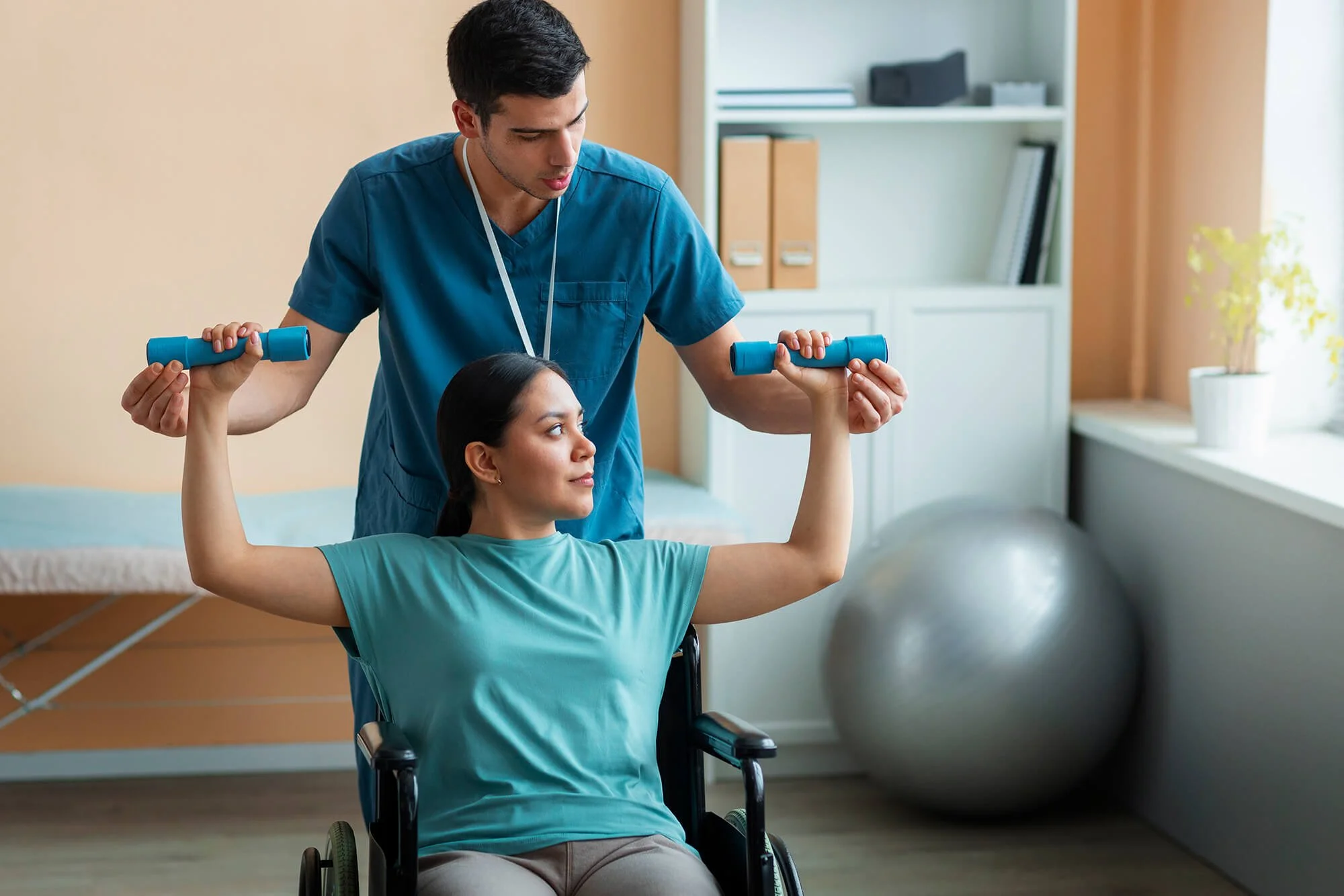
Exercise is not something most people with Parkinson's disease should do unsupervised, particularly as the condition progresses and falls risk increases. Physiotherapy and allied health support are what make exercise safe, targeted, and effective over the long term.
Physiotherapy - A physiotherapist experienced in Parkinson's disease will assess gait, balance, strength, posture, and movement quality, and design a program that addresses the specific deficits relevant to that person's presentation. Techniques include gait retraining with rhythmic and visual cueing, highly challenging balance training shown in clinical trials to reduce falls and improve postural stability, specific exercises targeting the axial muscles responsible for posture and trunk control, and motor relearning strategies that take advantage of neuroplasticity.
Exercise physiology - An accredited exercise physiologist plays a critical role in designing and supervising the structured exercise program at the heart of Parkinson's management. They assess cardiovascular fitness, muscular strength, and functional capacity, building a progressive program that delivers the intensity and volume needed to drive real clinical benefit, safely.
Technology-enhanced rehabilitation - At RehabX, physiotherapy and exercise physiology are supported by advanced rehabilitation technology specifically suited to Parkinson's disease rehabilitation:
The BTL R-Gait enables high-repetition robotic gait training, guiding the feet through a biomechanically correct walking pattern to address the gait changes characteristic of Parkinson's disease.
The THERA-Trainer Toro provides motor-assisted cycling for cardiovascular rehabilitation and lower extremity function, effective even in people with limited active movement capacity.
Speech pathology - As Parkinson's disease progresses, speech, voice, and swallowing are often affected. A speech pathologist experienced in Parkinson's disease, including approaches such as LSVT LOUD, which targets the reduced vocal volume common in Parkinson's, is a valuable part of the care team for many people.
What does a Parkinson's rehabilitation program look like?
No two people with Parkinson's disease are the same. The condition presents differently, progresses at different rates, and affects daily life in ways that vary enormously from person to person. This is why rehabilitation for Parkinson's must be personalised, not generic.
At RehabX, every person with Parkinson's disease begins with a comprehensive multidisciplinary assessment. This looks at the full picture: movement quality, balance and falls risk, strength, cardiovascular fitness, fatigue, speech and swallowing (where relevant), and what matters most to the person in terms of their daily life and goals.
From this assessment, a coordinated treatment plan is developed that typically combines physiotherapy sessions, exercise physiology and gym programming, technology-enhanced therapy for balance, gait, and upper limb function, and regular review against objective outcome measures to track and demonstrate progress.
Most active rehabilitation programs run for approximately twelve weeks, with regular reviews. After this, many people transition to a supported maintenance phase, continuing to exercise consistently with periodic check-ins to ensure the program remains appropriate as the condition evolves.
Parkinson's disease is progressive, but your response to it doesn't have to be passive
Starting rehabilitation early, before significant functional decline, produces the best outcomes
Exercise is not a replacement for medication. It works alongside it, and may reduce the rate at which medications need to be escalated
The goal is not simply to manage symptoms. It is to maintain independence, quality of life, and brain health for as long as possible
A good rehabilitation team doesn't just treat the condition. They support the whole person, including the emotional and psychological dimensions of living with Parkinson's
PD Warrior®: An Evidence-Based Approach to Parkinson's Rehabilitation
At RehabX, we're proud to offer the internationally recognised PD Warrior® program, delivered by clinicians who have completed specialised PD Warrior® training.
PD Warrior® is an evidence-based rehabilitation approach designed specifically for people living with Parkinson's disease. Rather than simply managing symptoms, the program uses targeted, high-effort exercise to help drive positive changes within the brain, a concept known as neuroplasticity.
The program focuses on helping people move with greater speed, power and intention, while improving balance, walking, posture, coordination and confidence in everyday life. Just as importantly, it equips participants with practical strategies and exercises they can continue at home, empowering them to take an active role in managing their condition.
At RehabX, PD Warrior® is integrated into a personalised rehabilitation program. Our clinicians combine the principles of PD Warrior® with multidisciplinary care and advanced rehabilitation technology where appropriate, ensuring every treatment plan is tailored to each person's goals, abilities and stage of Parkinson's disease.
For many people, PD Warrior® becomes more than an exercise program. It becomes a long-term strategy for maintaining mobility, independence and quality of life.
Start now. The evidence couldn't be clearer.
Of all the interventions available to people with Parkinson's disease, exercise is the one with the strongest evidence base for both symptom management and potential modification of the disease course. It is also the one most within your control.
The research is moving fast, and in a direction that should give people with Parkinson's disease, and their families, real hope. What we know now is that the brain is more responsive to exercise than we ever thought, and that starting an intensive, well-designed rehabilitation program is one of the most powerful decisions a person with Parkinson's can make.
At RehabX, we understand the complexity of Parkinson's disease, and we understand what it takes to design a program that is truly effective, not just active. Our multidisciplinary team, supported by world-class rehabilitation technology, is here to help you move better, feel stronger, and live fuller, for longer.
Ready to take the next step?
Book a Parkinson's rehabilitation assessment at RehabX. Our team will assess your current function, explain what a personalised program could look like, and answer every question you have.
Contact us today | rehabx.com.au | Book online: rehabx.com.au/booking-form
Or email us: enquiries@rehabx.com.au
About RehabX
RehabX is a specialist advanced rehabilitation centre located in North Lakes, Queensland. We deliver integrated, evidence-based care for people with neurological, musculoskeletal, and complex rehabilitation needs, bringing together a multidisciplinary team and world-class robotic rehabilitation technology under one roof.
Disclaimer: This article is intended for general educational purposes only and does not constitute medical advice. Please consult a qualified healthcare professional regarding your individual circumstances. All clinical claims in this article are based on published evidence available at the time of writing.