
What Happens After Stroke?
Your Complete Guide to Stroke Rehabilitation in Australia
A stroke changes everything, in an instant. One moment life is ordinary, and the next, everything feels uncertain. Whether you're a stroke survivor or a family member trying to understand what comes next, you're probably asking the same question: what happens now?
The good news is that recovery is possible. For many people, meaningful, life-changing improvement is achievable with the right rehabilitation, started at the right time, and delivered by the right team.
This guide walks you through everything you need to know about stroke rehabilitation in Australia, including what it is, when to start, what to expect, and how to find the support that gives you the best possible chance of getting your life back.
What is a stroke and why does rehabilitation matter?
A stroke occurs when blood supply to the brain is interrupted, either by a blocked artery (ischaemic stroke) or a burst blood vessel (haemorrhagic stroke). Within minutes, brain cells begin to die, which is why rapid medical treatment is so critical.
Stroke is one of Australia's most significant health challenges. In 2023, an estimated 45,785 Australians experienced a stroke, that's one stroke every 11 minutes. Close to half a million stroke survivors are currently living in the Australian community, and by 2050 the Stroke Foundation projects this number will grow to over 820,000 as the population ages.
Sources: Stroke Foundation Economic Impact of Stroke Report, 2024. AIHW Heart, Stroke and Vascular Disease: Australian Facts, 2025.
Every 11 mins
One stroke occurs
7,900
Deaths from stroke in 2024
~500,000
Stroke survivors in the community
45,785
Strokes in Australia in 2023
Sources: Stroke Foundation, 2024; AIHW, 2025
What happens after the immediate medical emergency, though, is just as important. A stroke can affect movement, speech, memory, swallowing, vision, emotions, sometimes all of these at once. The type and extent of impairment depends on which part of the brain was affected and how severely.
Rehabilitation is the structured process of relearning the skills that stroke has taken away. It works by harnessing one of the brain's most remarkable qualities: neuroplasticity.
What is neuroplasticity?
Neuroplasticity is the brain's ability to reorganise itself by forming new neural connections throughout life.
When one area of the brain is damaged by stroke, other areas can, with the right stimulation, learn to take over those functions.
Repetition is the key. The more times the brain practises a movement or skill, the stronger those new neural pathways become.
This is the science behind rehabilitation, and it means that recovery is rarely as limited as it might first appear.
When should rehabilitation start?
The short answer: as soon as possible.
Australian clinical guidelines recommend that stroke rehabilitation begins within 48 hours of hospital admission, provided the person is medically stable. Early mobilisation, even small movements in the hospital bed, has shown to reduce complications and set the stage for better recovery.
This matters because the brain is most receptive to change in the early weeks after stroke. This period of heightened neuroplasticity is sometimes called the 'recovery window', but it's important to note that neuroplasticity does not simply switch off. Recovery continues for months and sometimes years after stroke, particularly with intensive, targeted rehabilitation.
RESEARCH SPOTLIGHT
Recovery extends beyond the early post-stroke window
A study examining the temporal structure of neuroplastic recovery in stroke patients found evidence of a long-lasting critical period of enhanced plasticity that extends well beyond the conventionally cited 3–6 month window. The researchers uncovered a gradient of enhanced sensitivity to treatment that continued into late chronic stages, leading them to conclude that there is a clear need to provide rehabilitation to patients at chronic stages, not only in the early weeks after injury.
The key message for stroke survivors and families: don't wait, and don't accept that 'this is as good as it gets'. With the right support, progress is possible at every stage of recovery.
What does stroke rehabilitation include?
Stroke rehabilitation is rarely a single therapy. The most effective programs bring together a team of specialists, each addressing a different dimension of the stroke's impact on the person's life.
RESEARCH SPOTLIGHT
Multidisciplinary rehabilitation produces significantly better outcomes
A longitudinal study of 538 consecutive stroke patients assessed outcomes at 1, 3, 6, and 12 months across three groups: no rehabilitation, primary care rehabilitation, and multidisciplinary rehabilitation. Multidisciplinary rehabilitation resulted in significantly greater improvements in health-related quality of life and functional recovery compared to both other groups. Improvements in functional independence were maintained at three-year follow-up.
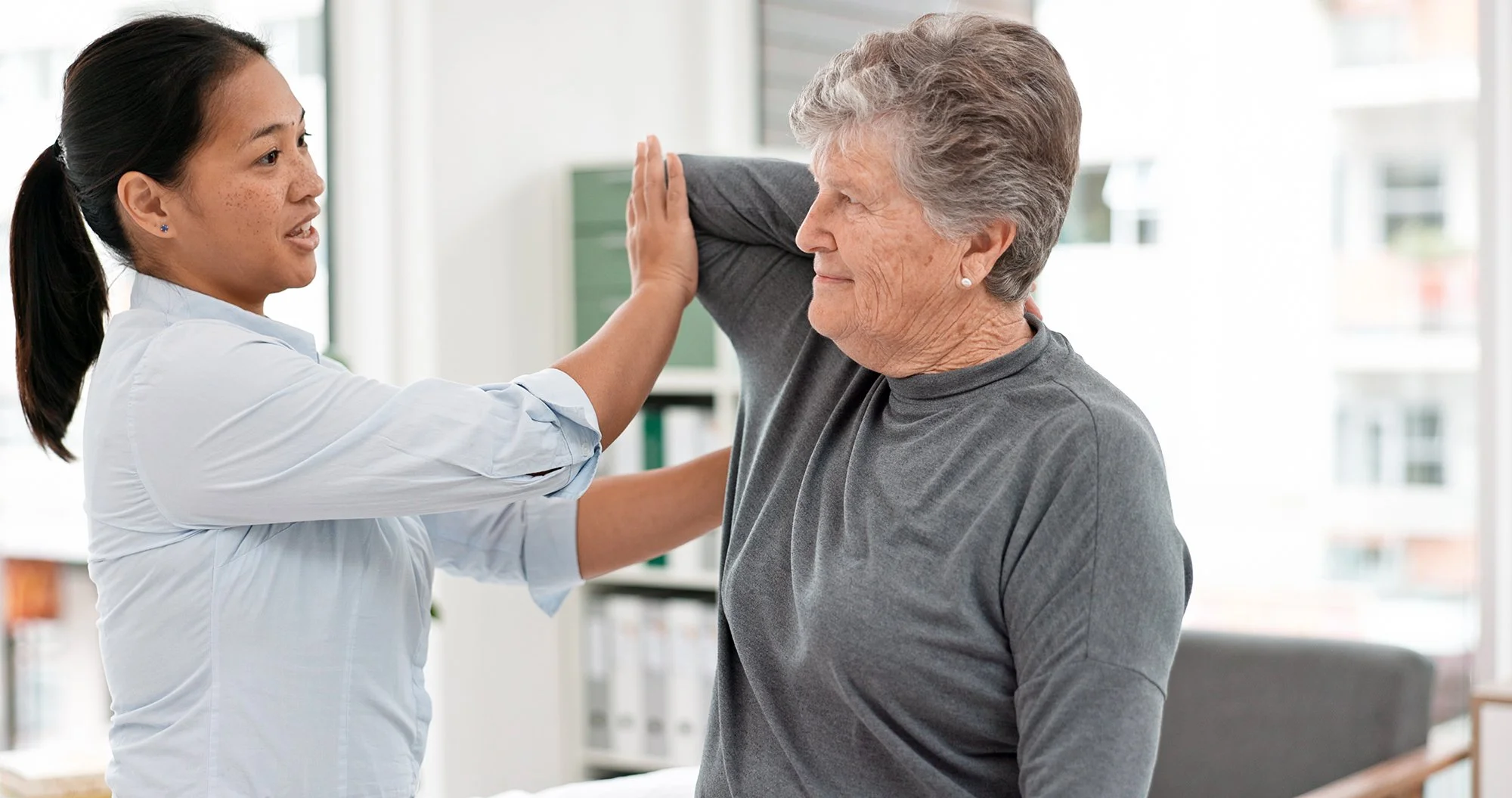
Here is what a comprehensive stroke rehabilitation program typically includes:
Physiotherapy - Physiotherapy focuses on movement, strength, and mobility. After stroke, this might include relearning to walk, rebuilding balance and coordination, or restoring the use of an arm or hand. Modern stroke physiotherapy uses evidence-based techniques, including robotic-assisted gait and hand therapy, to deliver the high volume of repetitive movement that neuroplasticity requires.
Occupational Therapy - Occupational therapy (OT) helps people return to the activities that matter most to them, including cooking, dressing, driving, caring for family. OT looks at the whole person in their environment, providing practical strategies, home modifications, and adaptive equipment to rebuild independence.
Speech Pathology - Stroke frequently affects communication and swallowing. Speech pathologists assess and treat aphasia (difficulty finding or using words), dysarthria (slurred speech), and dysphagia (swallowing difficulties). These are often among the most distressing consequences of stroke, and one of the most treatable.
Exercise Physiology - An accredited exercise physiologist designs and supervises therapeutic exercise programs to rebuild strength, cardiovascular fitness, and functional capacity. This is particularly important as rehabilitation progresses. Structured exercise helps consolidate physical gains and supports long-term health.
Technology-enhanced rehabilitation -Evidence increasingly shows that technology can meaningfully accelerate stroke recovery. Robotic devices, including robotic gait trainers and soft robotic gloves for hand rehabilitation, allow patients to practise movements with a level of repetition and precision that is simply not achievable through manual therapy alone. Biofeedback tools make even tiny movements visible, which is critical in the early stages of recovery when motivation needs a boost.
What to look for in a stroke rehabilitation program
A genuine multidisciplinary team, not just one discipline with others referred out
Programs that are goal-focused and individualised, not one-size-fits-all
Access to the latest evidence-based techniques and technology
Clear communication with you and your referring clinicians at every stage
A team that measures progress using validated outcome tools, so you can see how far you've come
How long does stroke recovery take?
There is no single answer to this question, unfortunately. Stroke recovery genuinely varies from person to person based on the severity and location of the stroke, how quickly treatment was received, the person's age and overall health, and the intensity and quality of their rehabilitation program.
What research consistently shows is this: the more intensive and targeted the rehabilitation, the better the outcomes. Programs that deliver higher volumes of practice, particularly in the first three to six months, produce measurably better results than lower-intensity approaches.
Most structured rehabilitation programs run for approximately twelve weeks, with regular reviews to assess progress and adjust the plan. After this, many people transition to a maintenance phase, continuing to build on their gains through supervised exercise, home programs, or periodic telehealth check-ins.
It’s important to note that recovery after stroke is not linear. There will be good days and harder days. Progress can feel slow, and setbacks can be discouraging. This is normal. With the right team around you, it doesn't have to feel like you're navigating it alone.
How is stroke rehabilitation funded in Australia?
Understanding your funding options is an important, and often overwhelming, part of navigating stroke recovery. Here is a plain-English overview of the most common pathways:
Private health insurance: If you have hospital cover and extras cover, you may be eligible for physiotherapy, occupational therapy, and speech pathology rebates. Check with your fund before booking, as annual limits and waiting periods vary.
NDIS: If your stroke has resulted in a permanent and significant disability, you may be eligible for the National Disability Insurance Scheme. The NDIS can fund a range of allied health services under 'Improved Daily Living' and 'Improved Health and Wellbeing' support categories. A registered NDIS provider can help you understand what your plan covers.
Home Care Package (Aged Care): If you are an older Australian, you may be eligible for government-funded support through a Home Care Package. Depending on your approved package and care plan, funding may be available for allied health services such as physiotherapy, occupational therapy and exercise programs delivered in the clinic or at home. If you're unsure of your eligibility, our team can help guide you through the process.
Medicare: Chronic Disease Management (CDM) plans prepared by your GP can provide Medicare rebates for a number of allied health sessions per year, including physiotherapy. Ask your GP whether you qualify.
Self-funded: Many families choose to invest privately in rehabilitation, particularly where waiting periods for publicly funded services are long or where they want access to specialist technology and programs not available in public settings.
Choosing a stroke rehabilitation provider
Not all rehabilitation providers are the same. In Australia, the sector ranges from hospital outpatient programs through to specialist private rehabilitation centres, and the quality, technology, and range of services available varies enormously.
When choosing a provider, ask the following questions:
Do they offer a genuine multidisciplinary team under one roof, or do they refer out to individual practitioners?
Do they use evidence-based techniques, and do they have access to technology that can support high-volume, high-quality practice?
Do they measure outcomes? Can they show you how patients progress through their programs?
Do they communicate clearly and regularly with your referring GP or specialist?
Do they have experience with your specific type of stroke presentation and its consequences?
The answers to these questions matter. Where you choose to do your rehabilitation will have a real impact on how far your recovery goes.
Recovery is possible. The right team makes all the difference.
A stroke is one of the most confronting experiences a person, or a family, can face. But it is not the end of the story. With early, intensive, and well-coordinated rehabilitation, many stroke survivors go on to recover function that they were told they might never regain.
The brain is more adaptable than most people realise. And the science of rehabilitation has never been better equipped to help it along.
If you or someone you love has recently had a stroke and you're trying to work out what to do next, we're here to help.
At RehabX, our multidisciplinary team brings together physiotherapy, occupational therapy, exercise physiology, speech pathology, podiatry, dietetics, remedial massage, a rehab gym and world-class robotic rehabilitation technology, all under one roof, all working together for one goal: your recovery.
Ready to take the next step?
Book a stroke rehabilitation assessment at RehabX. Our team will walk you through your options, explain what a program could look like for your specific situation, and answer every question you have, without any pressure.
Contact us today | rehabx.com.au | Book online: rehabx.com.au/booking-form
Or email us: enquiries@rehabx.com.au
About RehabX
RehabX is a specialist advanced rehabilitation centre located in North Lakes, Queensland. We deliver integrated, evidence-based care for people with neurological, musculoskeletal, and complex rehabilitation needs, bringing together a multidisciplinary team and world-class robotic rehabilitation technology under one roof.
Disclaimer: This article is intended for general educational purposes only and does not constitute medical advice. Please consult a qualified healthcare professional regarding your individual circumstances. All clinical claims in this article are based on published evidence available at the time of writing.